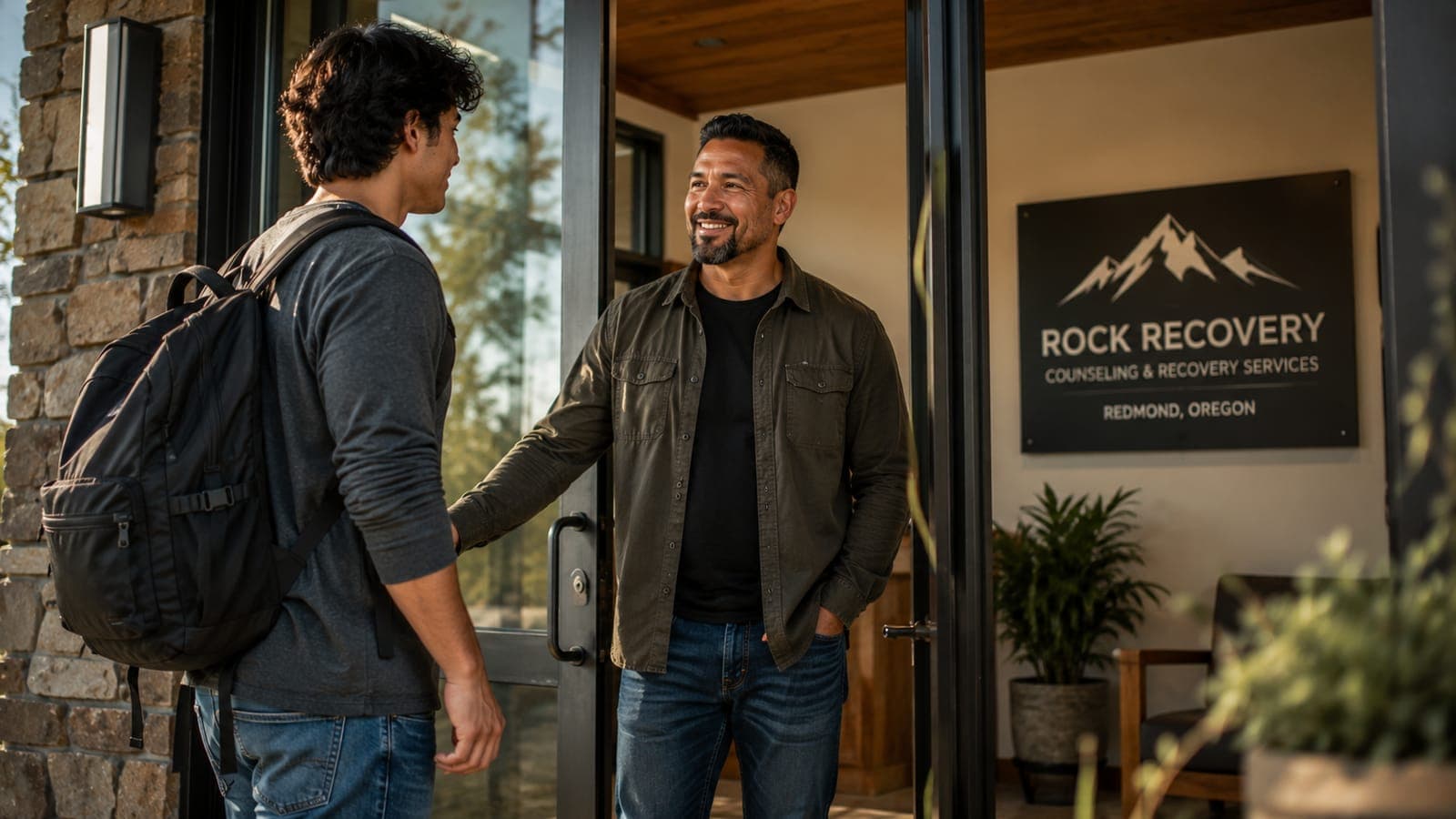
Most people don't wake up one day and decide they have a substance use disorder. It happens gradually: a couple of drinks after work that becomes a nightly habit, a prescription that runs out faster than it should, a weekend pattern that starts creeping into weekdays. Somewhere in that gray area, a lot of people in Central Oregon find themselves asking a quiet, uncomfortable question: is this actually a problem, or am I overthinking it?
That question is exactly what early intervention is built for. You don't need a crisis, a DUII, or a diagnosis to get support, and waiting for one of those things to happen first is not the safest path. This guide walks through what early intervention for substance use actually looks like, the signs worth paying attention to, and how Rock Recovery in Redmond, Oregon helps people get support before a risky pattern becomes a more serious disorder.
What Does "Early Intervention" Actually Mean?
In the world of licensed substance use treatment, "early intervention" isn't just a general phrase. It's an actual level of care. The American Society of Addiction Medicine (ASAM) defines a full continuum of care that ranges from early intervention through medically managed inpatient treatment, and ASAM's criteria are the framework that licensed Oregon providers, including Rock Recovery, use to match each client with the right level of care.
Early intervention sits at ASAM Level 0.5. It's built for people who show risk factors related to substance use but who don't yet meet the diagnostic criteria for a substance use disorder. In plain terms, people whose use has become concerning, but who aren't (or aren't yet) clinically dependent. Level 0.5 typically involves individual, group, or family counseling, structured education, and screening designed to help someone recognize risky patterns and change course, often through an approach called Screening, Brief Intervention, and Referral to Treatment (SBIRT). The Substance Abuse and Mental Health Services Administration (SAMHSA) describes SBIRT as "a comprehensive, integrated, public health approach to the delivery of early intervention and treatment services for persons with substance use disorders, as well as those who are at risk of developing these disorders."
That last phrase matters: at risk of developing a disorder, not already living with one. This is the level of care built specifically for people in the gray area, and in Central Oregon, it's also the level of care behind most DUII education and evaluation requirements, since those programs are designed around the same early-intervention model.
Signs It Might Be Time to Take a Closer Look
There's no single symptom that proves someone needs early intervention. Instead, it's usually a pattern: a handful of these signs showing up together, or getting more frequent over time. If you're reading this because something feels off, either about your own use or a loved one's, here are some of the most common signals worth paying attention to.
- It's become the plan, not the exception. Drinking or using is no longer something that happens occasionally at an event. It's become a default way to end the day, get through a stressful week, or unwind on weekends.
- The amount has quietly crept up. What used to be one or two drinks is now several. According to the National Institute on Alcohol Abuse and Alcoholism (NIAAA), binge drinking is generally defined as five or more drinks for men, or four or more for women, within about two hours, and heavy drinking is defined as exceeding that pattern on five or more days in a month. If that description fits more weeks than not, it's worth a closer look.
- You've tried to cut back and it hasn't stuck. Setting a limit ("just on weekends," "not before 5pm," "I'll skip it this week") and finding it doesn't hold is one of the clearest early indicators that use has more control than intended.
- Other people have said something. A partner, sibling, coworker, or close friend has mentioned a concern, even gently, more than once. Loved ones often notice the pattern before the person living it does.
- It's starting to bump into responsibilities. Being late or unfocused at work, skipping workouts or hobbies, missing calls with family, or feeling foggy the next morning. Even mild, occasional versions of this are worth noticing before they become routine.
- It's tangled up with stress, anxiety, or low mood. Using substances to manage anxiety, numb grief, or cope with burnout is extremely common, and it's also one of the strongest predictors that use will keep escalating unless the underlying stress or mental health piece gets addressed too.
- You've had a legal or medical wake-up call. A DUII stop, a concerning conversation with a doctor, or an ER visit related to substance use is often the first outside signal, even when the person involved doesn't yet see it as "a problem."
If a few of these sound familiar, that doesn't mean you're facing a severe substance use disorder. It often means you're in exactly the window early intervention was designed for.
You Don't Have to Wait for "Rock Bottom"
One of the most persistent myths about getting help is that it's only for people who have hit bottom: lost a job, a relationship, their health, or their freedom. NIAAA directly pushes back on this idea, stating plainly that "it's a myth that people who drink heavily or have AUD need to hit 'rock bottom' before changing their drinking patterns." NIAAA's research also notes that routine alcohol screening and brief intervention rank among the most cost-effective preventive health practices available, ranking higher, by some measures, than screening for high blood pressure or high cholesterol, precisely because they reach people while problems are still manageable rather than after a crisis has already occurred.
That's a meaningful shift in how to think about this. Getting support early isn't an overreaction, and it isn't jumping the gun. It's the version of care that has the best chance of working, with the least disruption to your life. And it doesn't only benefit the person using. NIAAA points out that family members of someone with risky alcohol use tend to experience more health problems and higher medical costs themselves, which means addressing a pattern early tends to protect the whole household, not just one person in it.
What Early Intervention Looks Like at Rock Recovery
Rock Recovery is licensed by the Oregon Health Authority (Certificate of Approval #001776) to provide the full continuum of substance use and mental health care, from early intervention through outpatient treatment. That range matters here, because it means an early intervention visit isn't a dead end or a generic pamphlet. It's a real clinical conversation with a team equipped to meet you wherever the assessment lands.
A typical early intervention path at Rock Recovery includes:
- A confidential screening. A licensed clinician asks straightforward questions about your use, patterns, and any related stress, using standardized, evidence-based screening tools rather than guesswork or judgment.
- An honest conversation about risk. Rather than labeling you, the clinician talks through what your specific patterns suggest, what the risks look like if nothing changes, and what your options are.
- Short-term, focused counseling or education. For people who fit ASAM Level 0.5, this might mean a handful of individual or group sessions focused on building awareness, developing coping tools, and making a concrete plan, not months of open-ended treatment.
- A clear next step either way. If the assessment shows a diagnosable substance use disorder, or a co-occurring mental health concern like anxiety, depression, or unresolved trauma, the same team can move you into the right level of outpatient care or into individual mental health counseling for the anxiety or stress underneath it, without sending you elsewhere to start over.
Because Rock Recovery's leadership, including co-founders Shawn and Eugene Reece, are in recovery themselves, and many staff bring lived recovery experience alongside their clinical licensure, early intervention conversations here tend to feel less like an evaluation and more like sitting down with someone who genuinely understands what you're weighing.
Who This Kind of Support Is For
Early intervention tends to fit a specific set of situations especially well:
- Working professionals whose drinking has escalated alongside job stress, and who want to address it privately before it affects performance or relationships.
- Parents who've noticed their own use creeping up and want to change course for their family's sake, before it becomes a bigger pattern.
- Young adults navigating college, a first job, or a new independence, where heavier drinking or drug use has become normalized among peers.
- People facing a DUII or legal flag who need an evaluation and want to understand, and get ahead of, what comes next. You can read more about DUII evaluation and education requirements in Deschutes County for the specifics of that process.
- Family members who are worried about a spouse, adult child, or sibling and want to understand what a conversation about getting screened might look like, and how to support a loved one through it without pushing them away.
What Happens When You Reach Out
Contacting Rock Recovery about early intervention doesn't commit you to anything beyond a first conversation. Most people start with a phone call or a form submission, followed by a scheduled assessment in Redmond. If you're wondering how that first visit actually goes, from paperwork to what the room looks like, Rock Recovery's guide on what your first visit looks like walks through it step by step, and Rock Recovery's team can also help you understand whether OHP covers this kind of care before you ever come in.
Frequently Asked Questions
What is early intervention for substance use?
Early intervention, known clinically as ASAM Level 0.5, is short-term counseling and education for people whose substance use is creating risk or concern but who don't yet meet the diagnostic criteria for a substance use disorder. It's designed to help someone change course before problems become more serious.
How is early intervention different from outpatient addiction treatment?
Outpatient addiction treatment (ASAM Level 1) is for people who meet at least two diagnostic criteria for a substance use disorder. Early intervention (ASAM Level 0.5) is for people whose use is risky or concerning but who don't meet that threshold. It uses shorter, more focused counseling and education rather than an ongoing treatment plan.
Do I have to wait until things get really bad before getting help?
No. Research from NIAAA notes it's a myth that people need to hit rock bottom before changing their drinking or drug use. Early screening and brief intervention are effective precisely because they reach people before a crisis develops.
Does Oregon Health Plan or private insurance cover early intervention services?
Rock Recovery accepts Oregon Health Plan (OHP), Medicare, and most private insurance. Coverage details vary by plan, and Rock Recovery's team can verify your specific benefits before your first visit.
What if the assessment shows I need more than early intervention?
That's exactly why Rock Recovery structures care the way it does. If an assessment shows a more complete substance use disorder or a co-occurring mental health concern, the same team can move you into the right level of care, including outpatient treatment or mental health counseling, without starting over with a new provider.
Can family members request an early intervention assessment for someone they're worried about?
A family member can reach out to ask questions, understand options, and learn how to talk with a loved one about getting an assessment, but the loved one themselves ultimately needs to participate in their own screening and counseling. Rock Recovery's team can talk through how to approach that conversation.
One Plan, One Team, the Whole Way Through
You don't need a diagnosis, a legal problem, or a rock-bottom moment to justify reaching out. If something about your use, or a loved one's, has been sitting in the back of your mind, that's reason enough to get a real, judgment-free answer. Rock Recovery's team in Redmond can screen you, talk through what your patterns actually mean, and build a plan around exactly where you are. And if that plan ever needs to grow into full outpatient treatment or mental health counseling for what's underneath it, it's the same team and the same plan the whole way through, with no re-referral and no starting over. Call Rock Recovery or fill out the contact form today to schedule a confidential assessment.